Buying Property in France as a US Citizen: Legal and Tax Considerations You Should Never Ignore
France remains one of the world’s most attractive destinations for American buyers seeking a second home, retirement residence, investment property or château. Whether you are looking for an apartment in Paris, a villa on the French Riviera, a vineyard in Bordeaux or a countryside estate, purchasing real estate in France requires careful legal and tax planning.
Unlike many jurisdictions, France combines civil law principles, mandatory notarial procedures and complex tax rules that may significantly impact your investment. For U.S. citizens, these issues become even more important because French and U.S. tax systems interact throughout the ownership period and upon resale or inheritance.
At FRELA, powered by DELCADE Avocats & Solicitors, our Franco-American team assists U.S. investors throughout every stage of their acquisition in France.


Can a U.S. Citizen Buy Property in France?
Absolutely.
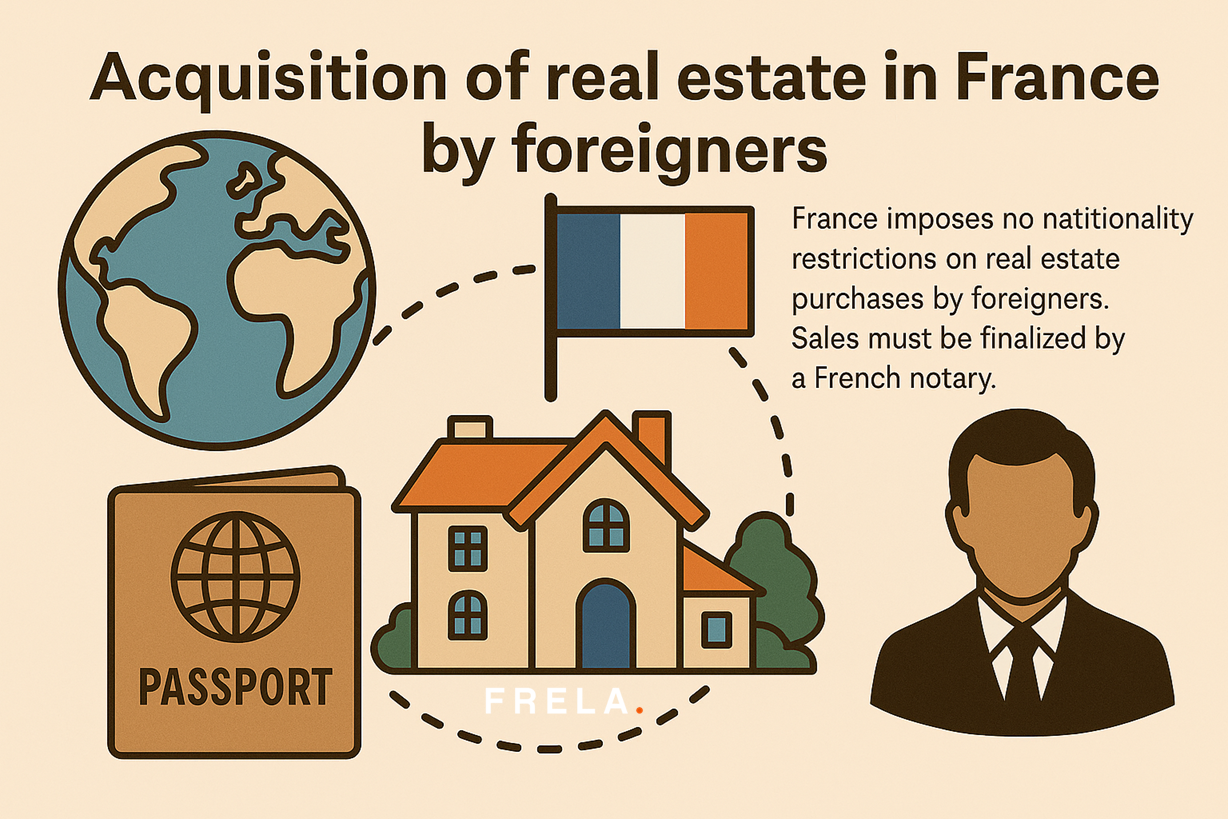
There are no restrictions preventing U.S. citizens or U.S. companies from purchasing French real estate. Buyers may acquire residential, commercial or investment properties in their own name or through an appropriate legal structure.
However, owning French real estate carries legal and tax consequences that should be evaluated before signing any offer or preliminary agreement.
Before You Sign Anything: Conduct a Legal Due Diligence
Many American buyers assume that the French notaire performs the same role as an American real estate attorney.
This is not the case.
The notaire is a public official whose role is to authenticate the transaction and ensure compliance with French law. While impartial, the notaire does not represent your individual interests or negotiate contractual protections on your behalf.
Having your own lawyer allows you to:
- review the purchase agreement before signature;
- negotiate key contractual clauses;
- analyse title issues and ownership history;
- review planning and zoning regulations;
- verify easements, rights of way and restrictions;
- assess co-ownership regulations (copropriété);
- identify hidden legal risks before they become costly disputes.
Our lawyers work alongside your notaire—not instead of the notaire—to protect your interests throughout the transaction.
Should You Buy Personally or Through a Company?
This is one of the most important decisions.
Depending on your objectives, the property may be acquired through:
- your personal name;
- a French SCI (Société Civile Immobilière);
- a French SAS;
- a U.S. LLC or corporation;
- another foreign holding company.
Each option has different implications regarding:
- French income tax;
- capital gains tax;
- inheritance tax;
- gift tax;
- wealth tax (IFI);
- U.S. reporting obligations;
- estate planning.
There is no universal solution. The appropriate structure depends on your residency, family situation, financing, investment strategy and long-term objectives.
Financing Your Acquisition
American buyers may obtain financing either from French banks or foreign lenders.
Before selecting a financing structure, it is important to review:
- mortgage registration costs;
- currency risks;
- tax deductibility of interest;
- guarantees requested by lenders;
- implications for cross-border wealth planning.
We regularly coordinate with French private banks and international lenders assisting foreign investors.
French Tax Issues Every U.S. Buyer Should Understand
Owning French real estate creates ongoing tax obligations.
Depending on your situation, you may be subject to:
Income Tax
Rental income generated in France is generally taxable in France, even if you live in the United States.
Double taxation is usually mitigated through the France-U.S. Tax Treaty, although reporting obligations remain in both countries.
Capital Gains Tax
When selling French real estate, capital gains may be taxable in France.
Various exemptions and reductions apply depending on:
- ownership period;
- tax residency;
- nature of the property;
- applicable tax treaty provisions.
Early planning can substantially improve the tax outcome.
Wealth Tax (IFI)
Non-residents may become liable for French Real Estate Wealth Tax (Impôt sur la Fortune Immobilière) if the value of their French real estate exceeds the applicable threshold.
Proper structuring may reduce unnecessary exposure.
Estate Planning and French Forced Heirship Rules
Many American buyers overlook one of the most significant aspects of French law: succession.
Unlike many U.S. states, French law contains mandatory inheritance rules (“forced heirship”) protecting certain heirs.
Without proper planning, your estate plan prepared in the United States may not produce the expected result for your French assets.
A coordinated review should include:
- wills;
- trusts;
- ownership structure;
- matrimonial regime;
- Brussels IV Regulation (where applicable);
- France-U.S. tax considerations.
Our lawyers regularly coordinate with U.S. estate planning attorneys to ensure consistency between both jurisdictions.
Purchasing Through a U.S. LLC: Is It Always Appropriate?
Many American investors naturally consider using their existing LLC.
However, a U.S. LLC may trigger unexpected consequences under French tax law.
Issues may include:
- tax transparency;
- corporate taxation;
- reporting obligations;
- inheritance planning complications;
- treaty interpretation.
Each situation requires an individual analysis before proceeding.
Protecting Your Investment After Completion
Legal support should not stop once the deed is signed.
We continue assisting clients with:
- rental contracts;
- property management agreements;
- renovation projects;
- tax compliance;
- ownership restructuring;
- succession planning;
- future resale.
Why Work with FRELA?
FRELA is dedicated to helping international investors acquire and protect French real estate.
Our multidisciplinary team combines expertise in:
- French real estate law;
- cross-border taxation;
- corporate structuring;
- inheritance planning;
- dispute resolution;
- immigration and relocation.
One of FRELA’s strengths is our international team, including U.S.-qualified lawyers and professionals familiar with both American and French legal systems. This enables us to work seamlessly with your U.S. attorneys, accountants, family office and wealth advisors, ensuring that your investment is structured efficiently on both sides of the Atlantic.
Whether you are purchasing your first apartment in Paris or investing in a multimillion-euro vineyard or hospitality asset, we provide practical, business-oriented advice tailored to international clients.
Planning to Buy Property in France?
Before signing any offer or purchase agreement, obtain legal and tax advice tailored to your personal circumstances.
A properly structured acquisition can help reduce tax exposure, avoid costly disputes and protect your investment for generations.
Contact FRELA today to discuss your French real estate project with our Franco-American legal team.
About the Author :
Business lawyers, bilingual, specialized in acquisition law; Benoit Lafourcade is co-founder of Delcade lawyers & solicitors and founder of FRELA; registered as agents in personal and professional real estate transactions. Member of AAMTI (main association of French lawyers and agents).
FRELA : French Real Estate Lawyer Agency, specializing in acquisition law to secure real estate and business transactions in France.
Paris, 15 rue Saussier-Leroy, Paris
Bordeaux, 24 Rue du manège, 33000 Bordeaux
Lille, 40 Theater Square, 59800 Lille

This article is provided for general information only and may not reflect the most recent legal or tax developments. It does not constitute legal advice. Please contact us for personalised guidance before making any decision.