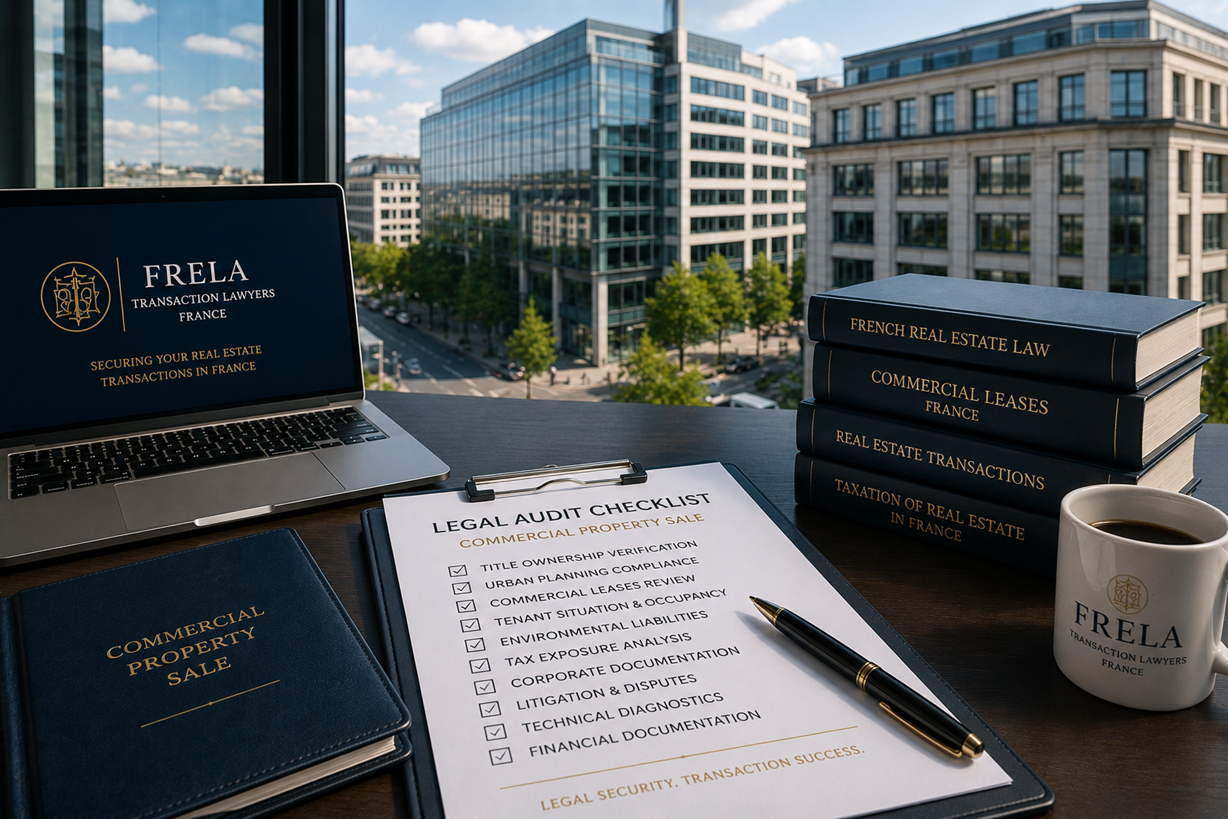
Cross-Border Real Estate Sales in France: How Foreign Owners Can Secure the Transaction
Selling real estate in France as a foreign owner involves far more than a standard property transfer. Cross-border transactions combine French property law, tax regulations, international compliance and foreign ownership structures, making them significantly more complex than domestic sales.
Whether the asset is a luxury villa, château, vineyard, hotel or commercial property, foreign sellers must anticipate legal and tax issues early in the process to secure the transaction and protect their financial outcome.
A poorly structured sale can create delays, disputes, double taxation or regulatory complications.
Preparation is key.


Why cross-border property sales in France are more complex
A French property sale involving a foreign seller usually raises several additional layers of complexity.
These often include:
- foreign tax residency
- offshore holding structures
- international inheritance planning
- foreign banking systems
- beneficial ownership disclosure
- anti-money laundering compliance
- multiple legal jurisdictions
This is especially true for high-value assets.
The higher the transaction value, the stronger the due diligence.
Buyers, notaries, banks and lawyers will expect complete transparency.
Clarifying ownership before selling
The first question is simple:
Who legally owns the property?
In cross-border situations, the answer is often not straightforward.
Ownership may involve:
- personal ownership
- a French SCI
- a foreign holding company
- a trust structure
- family ownership across several jurisdictions
- usufruct and bare ownership
Each structure creates different legal and tax consequences.
Before marketing the asset, sellers should clarify:
- the legal owner
- beneficial ownership
- powers of sale
- shareholder rights
- inheritance implications
Unclear ownership is one of the most common reasons for transaction delays.
Selling through a French company or foreign company
Many international investors hold French real estate through companies.
This raises an important question:
Is the sale structured as a direct property transfer or a share transfer?
Direct asset sale
The seller transfers the French real estate itself.
Advantages:
- clearer transaction perimeter
- easier for private buyers
- simpler legal reading
Challenges:
- transfer taxes
- notarial costs
- possible capital gains exposure
Share sale
The buyer acquires the company holding the property.
Advantages:
- operational continuity
- possible tax structuring benefits
- simpler transfer of associated contracts
Challenges:
- corporate due diligence
- hidden liabilities
- tax history exposure
The right structure depends on the asset and ownership model.
French capital gains tax for foreign sellers
One of the most important issues is taxation.
Foreign owners selling French property are generally taxable in France on their capital gains.
However, the effective tax burden depends on:
- country of tax residence
- ownership duration
- legal structure
- private or corporate ownership
- treaty protection
Holding period reductions
For private individuals, long-term ownership may reduce taxable gains significantly.
Non-resident taxation
Specific tax rates may apply to non-residents depending on their jurisdiction.
Tax representative obligations
In some cases, non-EU sellers may be required to appoint an accredited French tax representative.
This is often overlooked.
Double taxation risks
Foreign owners may also face taxation in their country of residence.
This creates potential double taxation.
France has tax treaties with many countries to reduce this risk.
These treaties may:
- allocate taxation rights
- provide tax credits
- define residency rules
- prevent double taxation
But treaty interpretation is technical.
Cross-border tax planning should always be reviewed before signing.
Anti-money laundering (AML) and compliance requirements
International real estate transactions in France are heavily regulated.
Notaries and lawyers must verify:
- identity of all parties
- source of funds
- beneficial ownership
- corporate chain of ownership
- tax compliance status
This is particularly important when:
- the seller is a company
- multiple jurisdictions are involved
- trusts are used
- funds move internationally
Incomplete documentation can stop the transaction.
Preparation avoids delays.
Legal due diligence before going to market
Foreign sellers should prepare a full legal audit before listing the property.
This improves speed and trust.
The audit should include:
Property title verification
Review:
- title deeds
- easements
- boundary issues
- planning compliance
Corporate documentation
If a company owns the property:
- articles of association
- shareholder registers
- resolutions
- tax declarations
- accounting records
Occupancy review
The seller must disclose:
- tenants
- lease terms
- occupancy rights
- vacant possession status
Tax review
A tax review should assess:
- latent capital gains
- VAT risks
- inheritance exposure
- corporate tax liabilities
This protects negotiation.
Inheritance and family ownership complications
Many foreign-owned French properties are inherited assets.
This often creates:
- fragmented ownership
- heirs in multiple countries
- conflicting succession laws
- tax exposure in several jurisdictions
French succession law may interact with foreign inheritance systems.
This must be reviewed before sale.
In some cases, restructuring ownership before marketing is advisable.
Buyer expectations in cross-border deals
International buyers are highly sensitive to legal clarity.
They expect:
- structured documentation
- fast due diligence
- clear ownership
- tax transparency
- clean title
- regulatory compliance
If the seller cannot provide this, negotiations become slower and more aggressive.
Premium buyers will often reduce their offer to reflect uncertainty.
Currency and banking considerations
Cross-border sales also create practical financial issues.
These include:
- currency exchange risk
- international wire compliance
- banking origin verification
- tax withholding mechanisms
Large transfers may trigger compliance checks.
These should be anticipated.
How to maximize security before selling
Foreign owners preparing to sell should:
- clarify ownership structures
- review tax exposure
- organize title documents
- resolve co-ownership disputes
- anticipate AML requirements
- verify planning compliance
- prepare corporate records
- review treaty implications
This preparation increases buyer confidence and protects value.
Secure your cross-border real estate sale in France
Selling French real estate as a foreign owner requires more than a buyer and a notary. Legal structuring, tax planning and international compliance are essential to securing the transaction.
For high-value assets, anticipation directly protects both price and timing.
At FRELA, we assist international owners, family offices and investors in structuring and securing cross-border real estate sales in France, from legal audits to tax optimization and transaction negotiation.
If you are preparing to sell property in France from abroad, early legal and tax advice can make a decisive difference.
About the Author :
Business lawyers, bilingual, specialized in acquisition law; Benoit Lafourcade is co-founder of Delcade lawyers & solicitors and founder of FRELA; registered as agents in personal and professional real estate transactions. Member of AAMTI (main association of French lawyers and agents).
FRELA : French Real Estate Lawyer Agency, specializing in acquisition law to secure real estate and business transactions in France.
Paris, 15 rue Saussier-Leroy, Paris
Bordeaux, 24 Rue du manège, 33000 Bordeaux
Lille, 40 Theater Square, 59800 Lille

This article is provided for general information only and may not reflect the most recent legal or tax developments. It does not constitute legal advice. Please contact us for personalised guidance before making any decision.