Preparing the Sale of a Commercial Property in France: Legal Audit Checklist
Selling commercial property in France requires much more than agreeing on a price and signing a deed. Whether the asset is an office building, retail premises, logistics warehouse, industrial site or mixed-use property, buyers expect a high level of legal clarity before committing.
For owners, a legal audit before sale is one of the most effective ways to secure the transaction, anticipate risks and protect the asset’s value.
This is particularly important for international owners, family offices and investors managing commercial assets from abroad.
A well-prepared commercial sale file improves negotiation strength, accelerates due diligence and reduces legal uncertainty.

Why legal audits matter before selling commercial property
Commercial real estate transactions are often more complex than residential sales.
This is because buyers are not only acquiring a physical asset. They are also acquiring:
- lease income
- tenant obligations
- operating risks
- urban planning constraints
- environmental exposure
- tax liabilities
- contractual obligations
Any unresolved issue can affect:
- valuation
- negotiation leverage
- buyer confidence
- financing approval
A legal audit helps identify these risks before the buyer does.
This shifts control back to the seller.
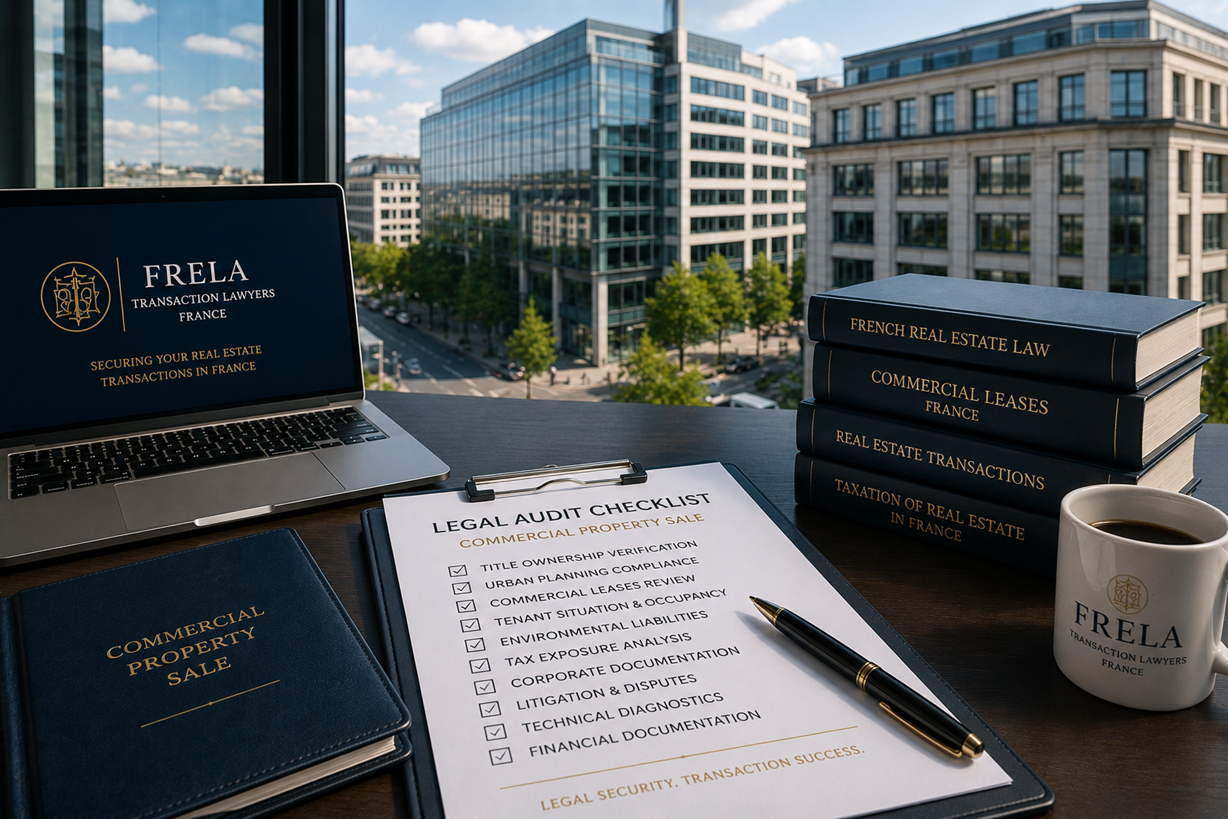
Step 1: Verify title ownership
The first step in any commercial property sale is ownership verification.
This sounds simple, but many issues can appear.
The seller should review:
- title deeds
- ownership history
- cadastral plans
- rights of way
- easements
- mortgage registrations
- security interests
Common problems include:
- outdated title records
- unresolved co-ownership
- unregistered modifications
- hidden rights affecting the property
Clear title is essential for a secure transaction.
Step 2: Review urban planning compliance
Commercial assets are heavily impacted by urban planning rules.
Buyers will verify:
- building permits
- extension permits
- occupancy permits
- zoning restrictions
- compliance with local planning law
This is especially important for:
- retail spaces
- logistics facilities
- hotels
- industrial sites
- mixed-use buildings
Unauthorized works can create serious liabilities.
Before sale, sellers should regularize any planning irregularities.
Step 3: Analyze all commercial leases
For income-producing assets, lease review is critical.
This is often the heart of the valuation.
Buyers will examine:
- lease duration
- renewal rights
- rent level
- indexation clauses
- break clauses
- tenant obligations
- unpaid rent history
- subletting rights
French commercial leases (“baux commerciaux”) create strong tenant protections.
The legal quality of these leases directly impacts asset attractiveness.
A weak lease can reduce value.
A strong lease strengthens price.
Step 4: Review tenant situation and occupancy risk
The seller must provide clarity on occupancy.
Questions include:
- Is the property fully occupied?
- Are tenants stable?
- Are there disputes?
- Are there vacancies?
- Are there arrears?
Occupancy affects both:
- immediate income
- buyer financing
Buyers usually assess tenant quality as much as the building itself.
Step 5: Check environmental liabilities
Commercial and industrial properties may carry environmental risks.
This is particularly sensitive for:
- warehouses
- factories
- logistics platforms
- fuel stations
- former industrial sites
The seller should review:
- pollution history
- environmental reports
- remediation obligations
- compliance certificates
Environmental exposure can significantly alter deal terms.
Ignoring this is dangerous.
Step 6: Review tax exposure
Tax planning is a key part of any commercial sale.
The seller should anticipate:
- capital gains tax
- corporate tax
- VAT treatment
- transfer duties
- local taxes
This depends on:
- ownership structure
- holding period
- private vs corporate ownership
- resident vs non-resident status
For foreign owners, cross-border tax implications must also be reviewed.
Tax treaties may affect the final taxation.
A commercial asset sold through a company may produce very different tax outcomes than a direct sale.
Step 7: Verify corporate documentation (if company-owned)
Many commercial assets in France are held through:
- SCI
- SAS
- holding companies
- foreign entities
If the buyer acquires the shares rather than the asset, corporate due diligence becomes essential.
The seller should prepare:
- articles of association
- shareholder registers
- annual accounts
- debt records
- tax filings
- board resolutions
This improves transaction speed.
Step 8: Review litigation and legal disputes
Buyers will want full disclosure.
The seller should identify:
- tenant disputes
- unpaid invoices
- construction claims
- zoning conflicts
- tax audits
- insurance claims
Undisclosed litigation creates trust issues.
Early disclosure often protects negotiation.
Step 9: Prepare mandatory technical diagnostics
French law requires specific diagnostics for many property sales.
Depending on the asset, this may include:
- asbestos
- energy performance
- lead
- natural risk exposure
- termites
- electrical systems
- gas systems
For commercial assets, technical compliance is often scrutinized.
This is especially true for institutional buyers.
Step 10: Organize financial documentation
A buyer will want to understand the asset’s profitability.
The seller should prepare:
- rental income history
- service charge recovery
- maintenance costs
- insurance costs
- tax charges
- CAPEX history
- tenant payment history
Commercial buyers buy yield.
Financial transparency improves valuation.
Asset deal or share deal?
Before launching the sale, sellers must determine whether the transaction will be:
- an asset sale
- a share sale
This changes:
- taxation
- liability allocation
- transfer costs
- due diligence scope
For investment-grade assets, share deals are often considered.
But this depends entirely on the legal structure.
How a legal audit protects value
A strong pre-sale audit allows the seller to:
- identify risks early
- resolve weak points
- improve buyer confidence
- reduce negotiation pressure
- accelerate closing
- secure valuation
In premium commercial transactions, buyers pay for clarity.
The cleaner the asset file, the stronger the deal.
Secure your commercial property sale in France
Selling commercial property in France requires preparation, legal structuring and risk anticipation. A pre-sale legal audit is one of the most effective ways to protect the transaction and maximize value.
At FRELA, we assist owners, investors and international clients in securing commercial real estate transactions in France through legal audits, lease reviews, tax structuring and transaction negotiation.
If you are preparing to sell a commercial asset in France, early legal advice can significantly improve the security and profitability of the transaction.
About the Author :
Business lawyers, bilingual, specialized in acquisition law; Benoit Lafourcade is co-founder of Delcade lawyers & solicitors and founder of FRELA; registered as agents in personal and professional real estate transactions. Member of AAMTI (main association of French lawyers and agents).
FRELA : French Real Estate Lawyer Agency, specializing in acquisition law to secure real estate and business transactions in France.
Paris, 15 rue Saussier-Leroy, Paris
Bordeaux, 24 Rue du manège, 33000 Bordeaux
Lille, 40 Theater Square, 59800 Lille

This article is provided for general information only and may not reflect the most recent legal or tax developments. It does not constitute legal advice. Please contact us for personalised guidance before making any decision.