
Compromis de Vente in France: What Sellers Must Secure Before Signing
In France, the Compromis de Vente is one of the most important legal steps in a real estate transaction. For sellers, it is far more than a preliminary agreement. It is the first binding contract that formalizes the sale and sets the legal framework of the transaction.
Once signed, both parties are committed, subject to specific conditions. This means that for sellers, many legal, tax and practical risks become much harder to correct after this stage.
Whether you are selling a villa, a château, a vineyard, a hotel or a commercial asset, preparing properly before signing the Compromis de Vente is essential to protect your interests and secure the transaction.
For international owners, this preparation is even more important.
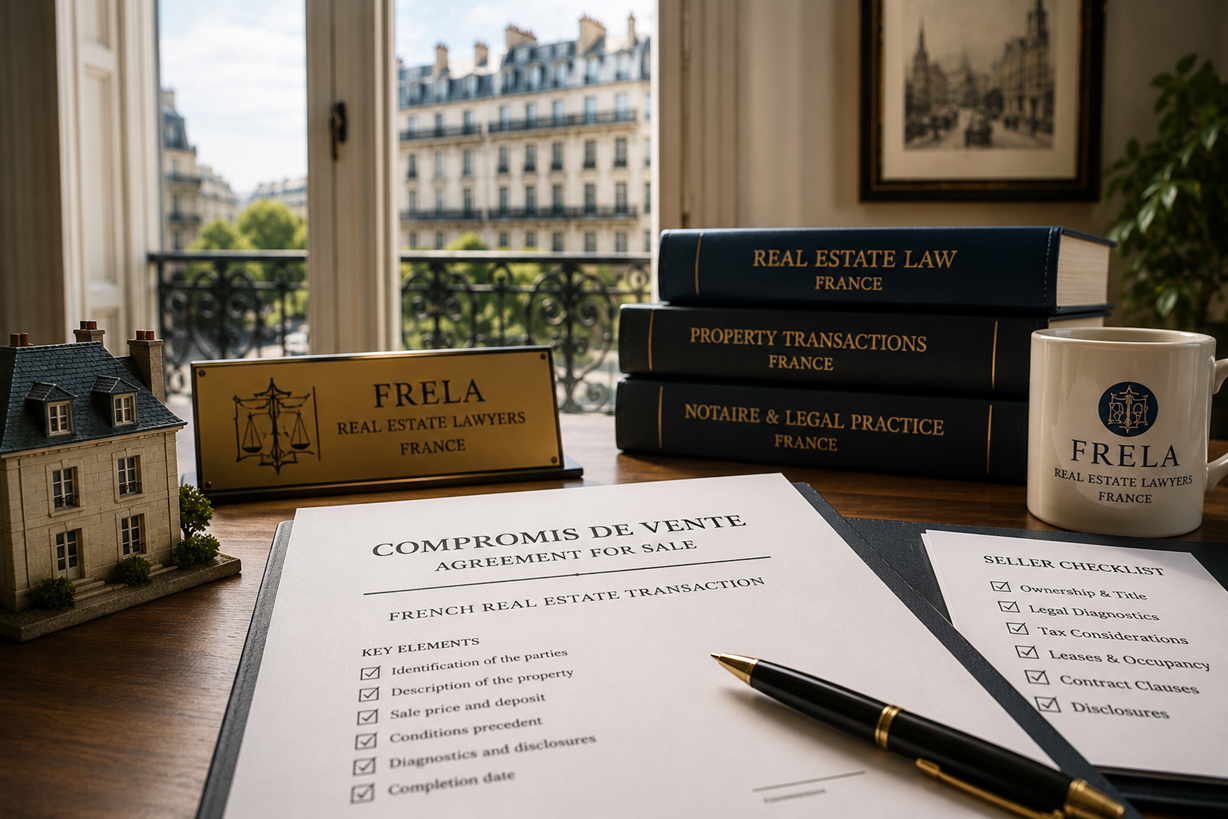

What is a Compromis de Vente in France?
The Compromis de Vente is the standard preliminary sale agreement used in French property transactions.
It defines the essential terms of the sale, including:
- the identity of the buyer and seller
- the description of the property
- the agreed sale price
- payment conditions
- legal diagnostics
- completion deadlines
- suspensive conditions
- legal declarations and warranties
Once signed, both seller and buyer are legally bound.
This differs significantly from simple negotiations or verbal agreements.
In practice, the Compromis de Vente creates the legal foundation for the final deed of sale (“Acte de Vente”), which is usually signed several weeks or months later.
Why the Compromis de Vente matters for sellers
Many sellers wrongly assume this document mainly protects the buyer.
This is incorrect.
The Compromis de Vente creates serious obligations for the seller.
Once signed:
- the sale price is fixed
- legal disclosures are frozen
- warranties begin to apply
- buyer due diligence intensifies
- liabilities become more visible
Any hidden issue discovered after signature can affect:
- the closing timeline
- the sale price
- negotiations
- the seller’s liability
For this reason, sellers should prepare carefully before signing.
What sellers must verify before signing
Before entering into a Compromis de Vente, sellers should secure several critical elements.
Title ownership and ownership rights
The first question is simple:
Do you have full legal authority to sell?
This becomes more complex when:
- the property is inherited
- ownership is shared
- the property is held through an SCI
- usufruct and bare ownership are separated
- foreign holding companies are involved
Ownership issues are one of the most common causes of delays.
The seller must verify:
- title deeds
- ownership chain
- shareholder rights
- powers of sale
A buyer will check all of this.
Co-ownership issues
If the property is jointly owned, all co-owners must be aligned.
Disagreements between family members, heirs or shareholders can block the transaction.
This is especially common for high-value family assets.
Resolving these issues before signing is crucial.
Existing leases and occupancy
Is the property vacant?
Or occupied?
Sellers must disclose:
- tenant leases
- commercial occupancy
- agricultural occupancy
- short-term rental commitments
- rights of use
Occupancy directly impacts value.
A buyer must know exactly what is being transferred.
Mandatory diagnostics
French law requires the seller to provide specific technical reports.
Depending on the asset, these may include:
- asbestos
- lead
- energy performance
- termites
- gas
- electricity
- natural risks
Missing or outdated diagnostics can delay the transaction.
They may also create liability.
Urban planning compliance
Has every extension, renovation or structural change been properly authorized?
Buyers often review:
- building permits
- declarations of works
- zoning compliance
- land use restrictions
Unauthorized works can create negotiation pressure or even cancellation risks.
Hidden defects and disclosure obligations
French sellers must disclose known issues affecting the property.
This may include:
- structural defects
- drainage problems
- boundary disputes
- easements
- pollution
- insurance claims
Failing to disclose can create post-sale liability.
This is particularly important for luxury and commercial properties.
Tax exposure and capital gains
Before signing, sellers should anticipate:
- capital gains tax
- non-resident tax exposure
- corporate tax implications
- VAT treatment
- wealth tax consequences
Many sellers only think about tax after signing.
That is often too late.
Tax planning should be done before the Compromis de Vente.
Compromis de Vente vs Promesse de Vente
These two documents are often confused.
But they work differently.
Compromis de Vente
In a Compromis de Vente:
- both parties are committed
- the buyer agrees to buy
- the seller agrees to sell
It is bilateral.
Promesse de Vente
In a Promesse de Vente:
- only the seller commits
- the buyer receives an option to buy
- the buyer may withdraw
The buyer usually pays an option fee.
For sellers, the Compromis de Vente generally provides stronger commitment from the buyer.
But it also requires stronger preparation.
Suspensive clauses: protecting the seller
Suspensive clauses are conditions that must be fulfilled before the sale becomes final.
Typical examples include:
- financing approval
- planning approval
- pre-emption rights
- legal regularization
For sellers, these clauses must be carefully reviewed.
Poorly drafted conditions may create unnecessary uncertainty or give the buyer excessive flexibility.
Negotiating these clauses properly is essential.
What happens after signing?
After the Compromis de Vente is signed, the notary begins the final verification process.
This usually takes between two and three months.
The notary will review:
- title validity
- mortgage registrations
- pre-emption rights
- planning status
- tax compliance
- legal diagnostics
Additional buyer due diligence may also continue during this period.
If the seller’s file is incomplete, this phase can become significantly longer.
A well-prepared file accelerates closing.
Why legal advice matters before signing
Many sellers rely exclusively on the notary.
But the notary remains neutral.
The notary secures the legality of the transaction, not the strategic protection of the seller.
A seller-focused legal adviser can help:
- review liabilities
- negotiate clauses
- assess tax exposure
- structure ownership
- identify risks
- anticipate disputes
This is particularly important for international sellers and high-value assets.
Secure your sale before signing
The Compromis de Vente is not just an administrative step. It is one of the most strategic moments of the sale.
For sellers, preparation before signature can directly affect:
- legal security
- tax exposure
- negotiation power
- transaction speed
- final net proceeds
At FRELA, we assist property owners, investors and international sellers in securing their real estate transactions in France, from legal audits to tax structuring and contract review.
If you are preparing to sign a Compromis de Vente in France, obtaining legal advice before signing can make a decisive difference.
About the Author :
Business lawyers, bilingual, specialized in acquisition law; Benoit Lafourcade is co-founder of Delcade lawyers & solicitors and founder of FRELA; registered as agents in personal and professional real estate transactions. Member of AAMTI (main association of French lawyers and agents).
FRELA : French Real Estate Lawyer Agency, specializing in acquisition law to secure real estate and business transactions in France.
Paris, 19 Rue du Colisee, 75008 Paris
Bordeaux, 78 Cours de Verdun, 33000 Bordeaux
Lille, 40 Theater Square, 59800 Lille

This article is provided for general information only and may not reflect the most recent legal or tax developments. It does not constitute legal advice. Please contact us for personalised guidance before making any decision.